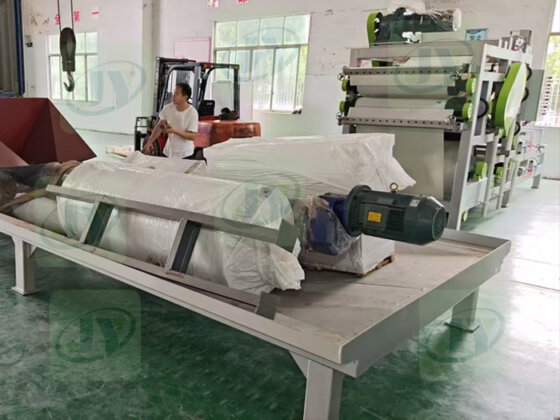
Core Classification of Belt Press Dewatering Machines (By Structure & Pressing Method):
- Structural Features: Equipped with only 1 set of pressing rollers (usually an integrated “pre-pressing + main pressing” design). The filter belt has a short running path, and the overall equipment is compact, occupying an area of approximately 2-5㎡.
- Application Scenarios: Suitable for materials with low initial moisture content (70%-85%) or scenarios with low dehydration requirements, such as pre-treatment of lightly dehydrated fruit and vegetable residues, and traditional Chinese medicine residues.
2. Two-Stage Belt Press Dewatering Machine
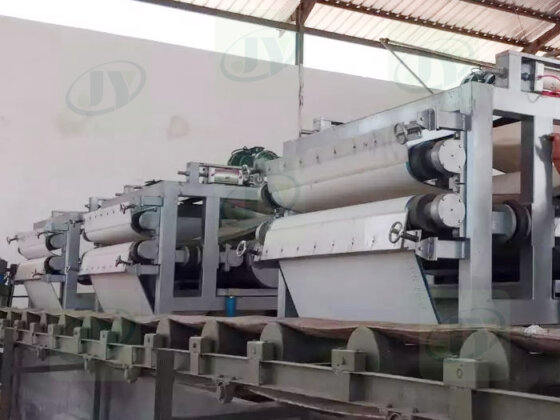
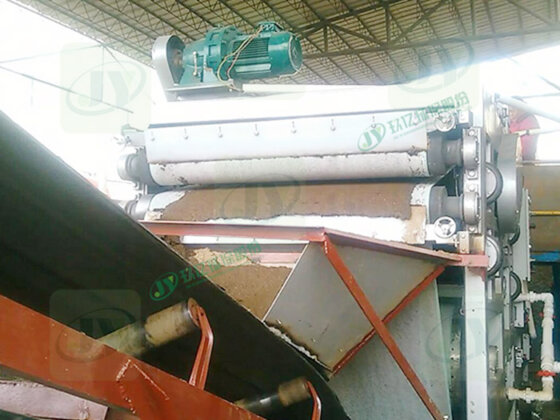
- Structural Features: Divided into a “pre-pressing section” (multiple sets of low-pressure rollers for initial water squeezing) and a “pressing section” (high-pressure rollers/pressing cylinders for deep dehydration). The filter belt tension is adjustable, and some models are equipped with automatic deviation correction and cleaning functions.
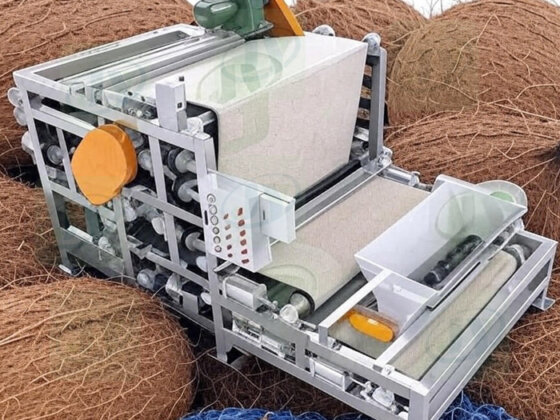
- Application Scenarios: Ideal for materials with medium to high initial moisture content (85%-95%), such as cow manure, beer lees, and coconut coir. It is the mainstream model in the current market and meets most industrial/agricultural dehydration needs.
3. Three-Stage Belt Press Dewatering Machine
- Structural Features: Adds a “precision pressing section” (ultra-high-pressure rollers or diaphragm pressing devices) to the two-stage design for enhanced dehydration. Some models are equipped with temperature control/moisture retention modules to prevent material drying and hardening.
- Application Scenarios: Suitable for high-viscosity, high-moisture materials that require low final moisture content, such as sludge (municipal/industrial sludge), starch residues, and papermaking black liquor sludge. The final moisture content can be reduced to 50%-60%.
4. Vacuum-Assisted Belt Press Dewatering Machine
- Structural Features: Combines “vacuum suction” şi “mechanical pressing”. The pre-pressing section uses vacuum suction cups to first remove part of the free water, then the material enters the pressing section for squeezing. The filter belt has finer pores.
- Application Scenarios: Suitable for materials with fine particles that are prone to clogging the filter belt, such as kaolin, graphite residues, and ultra-fine waste residues in the food industry (e.g., soy milk residue), avoiding clogging issues in traditional pressing.
 Cocos de nucă de cocos,